

Giving Math the Time It Deserves
A thoughtful pace. A meaningful place in our children's education.
Hi friend,
Let's continue with our series on other subjects involved in a Charlotte Mason Education besides those we offer in Fostering Wonder. Next on the list is-- Math!
Math can feel intimidating, even for the parent teaching it. My husband is an engineer, and in our home we take math seriously. I want it to receive the same care and purpose we give the other subjects in a Charlotte Mason education.
It is easy to delight in living books, nature study, art, and music, then approach math as another box to check. But math belongs in that beautiful, connected education too. We see it in the patterns of nature, the shapes and proportions of art, the rhythms of music and poetry, and the puzzles and patterns we encounter in everyday life.
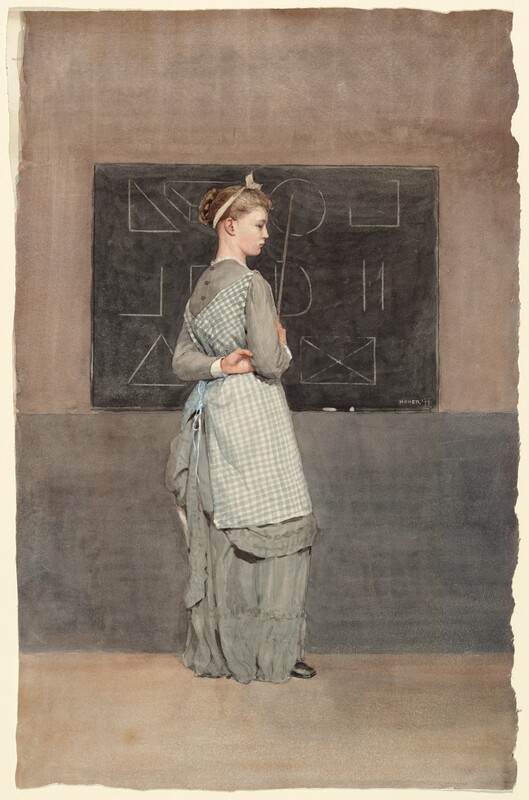
Winslow Homer, Blackboard, 1877.
National Gallery of Art. Public domain.
Give understanding time
One simple way I make room for math is to set a timer instead of requiring a certain number of lessons. Here are the time windows I suggest, adjusting for the child and the material:
Grades 1-3: 10-15 minutes
Grades 4-6: 20-30 minutes
Grades 7-12: gradually increase to 40-45 minutes
These are practical starting points for your family, rather than a fixed Charlotte Mason timetable.
As the material grows more complex, our time grows with it. Younger children generally work with simpler problems, while older students need room to work through several steps and layers of thought.
A timer gives us permission to slow down when a problem needs more explanation or support and move more quickly through what a child has mastered. It protects time for focused work without making a page count the measure of success. The timer is a boundary for the lesson, not a race to finish.
“Haste makes waste.”
My high school trigonometry teacher said those words, and they have stayed with me. Now I say them to my own children.
There is so much pressure to push, push, push and rush, rush, rush, even when a child has not understood the concept. We worry about being “left behind.” But who is setting that pace, and does it serve the child in front of us?
Our children are persons, each with their own interests, strengths, and weaknesses. We can take math seriously while honoring those differences. We can expect careful attention and steady effort while giving understanding the time it needs.
This week, try setting aside a focused window for math. Sit beside your child, notice where help is needed, and let understanding guide the pace.
Warmly,
Scarlette
Fostering Wonder
 YouTube
 Instagram